

80 questions
Once-through & multi-boiler
How long does a once-through boiler take from start-up to steam?
A once-through steam boiler can supply steam in about 4–5 minutes, because water flows through the heating tubes and turns directly into steam, so the boiler does not hold a large volume of water. A conventional large boiler must first heat a large volume of boiler water, which can take 30 minutes to 1 hour.
From:What Is a Boiler? Types, How It Works, Uses and Selection
What are the benefits of a multi-boiler installation?
Three major advantages: flexible dispatch, with the number of boilers needed starting automatically according to steam demand, avoiding a large boiler doing a small job; maintenance without interrupting production, since the others keep supplying steam while one is serviced; and spread risk, so a problem with one unit does not shut everything down.
Why are once-through boilers safer?
Because the water capacity is small, steam is produced and used almost instantly and large amounts of high-pressure steam are not stored for long periods. The boiler is also fitted with low-water protection, flame monitoring, safety valves, pressure control and automatic combustion control; in an abnormal situation the system stops combustion automatically and sounds an alarm.
From:Taiwan Once-Through Boiler Regulations: Inspections and Operator Licences
How does a once-through steam boiler work?
Cold water is fed in by the feedwater pump and flows continuously through many small, high-pressure heat exchange tubes. The tubes are heated by the burner, and the water heats up within a few seconds, becoming high-pressure steam by the time it has flowed through the whole tube. It can supply the process immediately, with no extra steam drum or long wait.
What are the differences between once-through, fire-tube and electric boilers?
Once-through boilers are compact and produce steam within 5 minutes of start-up, suiting food factories and small processes; fire-tube boilers have large capacity and stable pressure, suiting large-scale continuous operation; electric boilers generate heat directly from electricity, suiting medical, laboratory and small clean-steam needs.
What safety protections do once-through boilers have?
They include ignition-failure protection, abnormal-pressure shutdown protection, low-water alarm and shutdown, an overheat protection system, and automatic fault logging with diagnostic display. With the touch control panel, technicians can see the boiler's status at any time.
What are the disadvantages of once-through steam boilers?
The maximum output of a single unit is usually 2,000–3,000 kg/hour, so large factories often need several units together; the initial investment is higher than for a conventional boiler; and it is strict about water quality, since untreated hard water speeds up scale formation, so water treatment equipment and its maintenance cost are needed.
How does a multi-boiler once-through installation work?
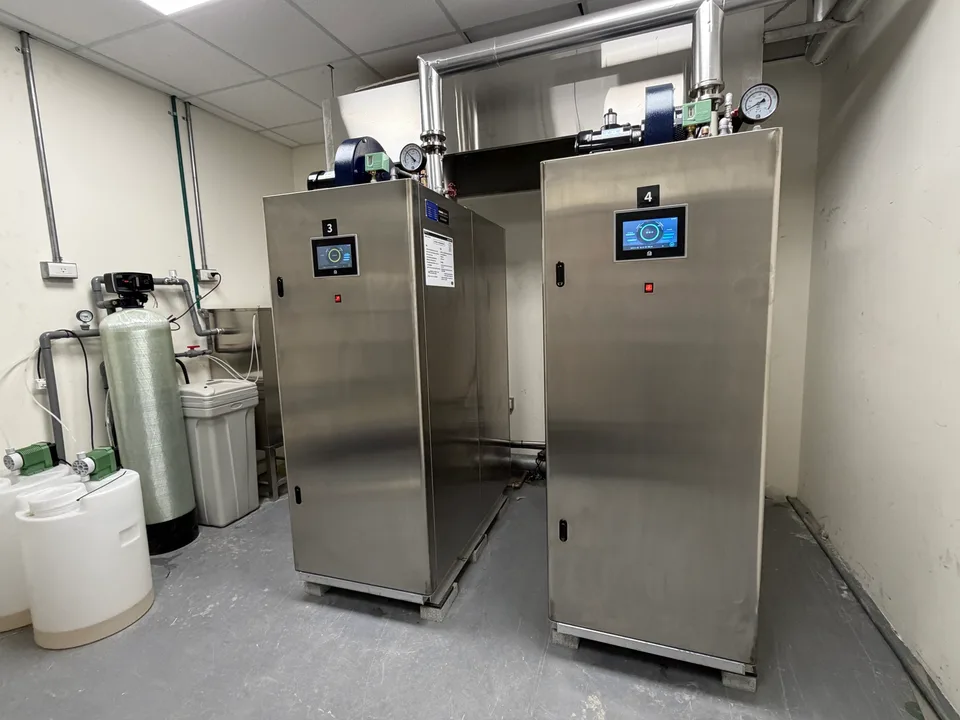
With three boilers as an example, one starts at low load, two run during normal production, and all three run together at peak demand, so one oversized boiler is never left running at low load for long. When one is being serviced or has a fault, the others can still supply part of the steam.
From:Once-Through vs. Large Horizontal Boilers: A Full Cost Comparison
What is the boiler's HMI control panel for?
The HMI control panel with PLC smart control provides real-time monitoring, shows pressure and fault codes, saves abnormality and history records, and helps with repair tracing. Its greatest value is shortening downtime, so troubleshooting no longer relies on experience alone.
How much installation space does a once-through boiler need?
Once-through boilers are compact, and some models are even small enough to pass through an ordinary factory doorway or freight elevator. The structure is tight, and they can stand against a wall or side by side, suiting space-limited sites such as small urban factories, school central kitchens and hotels.
Why are once-through boiler pressures not designed to exceed 10 kg/cm²?
In Taiwan, if a once-through boiler's maximum working pressure exceeds 10 kg/cm², it is no longer a small boiler but hazardous equipment as defined in Taiwan's Regulations for Safety Inspection of Dangerous Machinery and Equipment. An inspection body must carry out completion, periodic and other inspections, and the requirements for design, manufacturing and use management are also higher. Chuang Ting therefore keeps its pressure design within 9.9 kg/cm².
Rules change over time. This is general information only: please check the latest announcements of Taiwan's competent authorities (such as the Ministry of Labor and the Ministry of Environment), and confirm with them or an inspection body when needed.
Buying & costs
What conditions should be confirmed before buying a boiler?
First confirm the actual heat demand, including quantity and required temperature, then consider operating pressure, fuel type, cost and environmental regulations. For example, food processing may need a stable medium-to-low temperature heat source, while the chemical industry may need high-temperature, high-pressure steam.
How do I choose between natural gas, diesel and electric boilers?
Natural gas burns cleanly and efficiently and suits urban areas; diesel is flexible and suits factories where gas pipelines are inconvenient; electric heating is easy to install and suits small sites or places with high environmental requirements. When choosing, balance the convenience of fuel supply against long-term running costs.
How do I assess steam demand when choosing a boiler?
First confirm the daily output and the steam pressure required. Food steaming and sterilization often need medium-pressure, high-flow steam, while a restaurant kitchen may need only steady low-pressure steam; the differences between production lines are large.
Besides price, what else should I compare when buying a steam boiler?
Compare the items a catalog does not show: how easy the control system is to use, combustion tuning capability, the ability to integrate the boiler, piping and site conditions into one system, and speed and judgment when problems arise.
From:You're Not Just Buying a Boiler. You're Buying Support When It Stops.
How long does a boiler energy-saving retrofit take to pay back?
It depends on the site's steam use and the scope of the retrofit; about 3-5 years is common. In a food plant the boiler often accounts for a considerable share of energy costs, so boiler selection should assess the ten-year total cost of ownership, not just the upfront purchase price.
Should a boiler be repaired or replaced?
There are five self-assessment items: more than 10 years in service, annual repair costs reaching 20% of a new boiler, frequent abnormal pressure or alarms, energy bills rising year after year, and discontinued parts or an aging control box. If three or more apply, replacing the boiler is usually more cost-effective than repairing it.
When should you start evaluating boiler replacement?
Start evaluating when the boiler reaches 8–10 years of age, when next year's capacity must rise or the plant is relocating, when Taiwan's regulations or energy efficiency standards are about to tighten, or when parts can no longer be replaced. Planning early avoids an emergency replacement after a shutdown.
Rules change over time. This is general information only: please check the latest announcements of Taiwan's competent authorities (such as the Ministry of Labor and the Ministry of Environment), and confirm with them or an inspection body when needed.
Taiwan regulations & licenses
Do operators of once-through steam boilers in Taiwan need a license?
Yes. Under Taiwan's Occupational Safety and Health Education and Training Rules, small-boiler operators must complete the small-boiler operator safety and health training. Whether another boiler operation qualification can substitute, and how many staff must be on site, are determined by the competent authority or an inspection body in Taiwan according to the actual model and site conditions. In practice, a company only needs to send its existing employees to a course run by a qualified training provider.
Rules change over time. This is general information only: please check the latest announcements of Taiwan's competent authorities (such as the Ministry of Labor and the Ministry of Environment), and confirm with them or an inspection body when needed.
From:Taiwan Once-Through Boiler Regulations: Inspections and Operator Licences
Are once-through boilers in Taiwan always exempt from inspection and licensing?
It cannot be summed up in one sentence. In Taiwan, Chuang Ting once-through boilers have a heating surface under 10 m², which lightens the burden of inspections, operator qualifications and staffing. But whether a boiler is actually exempt from inspection, and what qualifications operators need, must still be confirmed according to model, pressure, heating surface, number of boilers and site layout.
Rules change over time. This is general information only: please check the latest announcements of Taiwan's competent authorities (such as the Ministry of Labor and the Ministry of Environment), and confirm with them or an inspection body when needed.
From:Once-Through vs. Large Horizontal Boilers: A Full Cost Comparison
What is a small once-through boiler as defined by Taiwan's regulations?
Under Article 3, Item 6 of Taiwan's Regulations for the Safety of Boilers and Pressure Vessels, a small once-through boiler must meet all of these: maximum working pressure of 10 kg per square centimeter (1 MPa) or below and heating surface of 10 square meters or below; multi-tube once-through boilers with a cylindrical header of more than 150 mm inner diameter, or a square header with a cross-sectional area of more than 177 square centimeters, are excluded; and where there is a steam separator, its inner diameter must be 300 mm or less and its internal volume 0.07 cubic meters or less. Heating surface does not include the superheater and economizer. The heating surface of every Chuang Ting once-through steam boiler series is under 10 square meters.
Rules change over time. This is general information only: please check the latest announcements of Taiwan's competent authorities (such as the Ministry of Labor and the Ministry of Environment), and confirm with them or an inspection body when needed.
From:Taiwan Once-Through Boiler Regulations: Inspections and Operator Licences
What training is needed to operate a small boiler?
People who actually operate small boilers must complete the "small boiler operator" safety and health training set by Taiwan's Occupational Safety and Health Education and Training Rules: 18 hours in total, of which 6 hours are safe-operation practice; after completing it, they must take at least 3 hours of in-service training every three years. Fees are as announced by each training provider. It applies whether the site is a hotel, school, central kitchen, food factory or swimming pool, as long as someone actually operates a small boiler.
Rules change over time. This is general information only: please check the latest announcements of Taiwan's competent authorities (such as the Ministry of Labor and the Ministry of Environment), and confirm with them or an inspection body when needed.
From:What Is a Boiler? Types, How It Works, Uses and Selection
Should small once-through boilers be managed like large boilers?
Not exactly the same. In Taiwan, a once-through boiler that meets the small-boiler definition in the Regulations for the Safety of Boilers and Pressure Vessels is not among the dangerous equipment that the Regulations for Safety Inspection of Dangerous Machinery and Equipment require an inspection body to inspect; its construction must comply with the national standard for small boilers, and its operators must complete small-boiler operator training. How other rules, such as boiler room layout, apply is determined by the competent authority or an inspection body according to the actual model and site conditions.
Rules change over time. This is general information only: please check the latest announcements of Taiwan's competent authorities (such as the Ministry of Labor and the Ministry of Environment), and confirm with them or an inspection body when needed.
From:Taiwan Once-Through Boiler Regulations: Inspections and Operator Licences
What operator qualifications are needed for a large horizontal boiler?
Under Taiwan's Regulations for the Safety of Boilers and Pressure Vessels, when one boiler room has two or more boilers, a boiler work supervisor must be assigned according to the total heating surface: 500 square meters or more requires Class A qualification, 50 or more but under 500 square meters requires Class B or higher, and under 50 square meters requires Class C or higher; if all the boilers are once-through, the first two cases may be filled by someone with Class B or higher and Class C or higher respectively. When totaling, once-through boilers and certain others may count a reduced heating surface as the regulations provide. The qualification actually required is determined by the competent authority or an inspection body in Taiwan according to the actual model and site conditions.
Rules change over time. This is general information only: please check the latest announcements of Taiwan's competent authorities (such as the Ministry of Labor and the Ministry of Environment), and confirm with them or an inspection body when needed.
From:Once-Through vs. Large Horizontal Boilers: A Full Cost Comparison
What are the rules on entrances, exits and clearances in a boiler room?
Under Taiwan's Regulations for the Safety of Boilers and Pressure Vessels, a boiler room must have at least two entrances and exits (except where they would not impede an operator's emergency escape); keep a clear distance of at least 1.2 meters between the top of the boiler and overhead structures such as the ceiling, beams and piping (except where inspection, adjustment or operation of the safety valve and other accessories is not impeded); for vertical boilers or boilers whose outer shell has no covering, keep at least 45 cm from the outer wall to walls, piping and the like, or at least 30 cm for boilers with a shell inner diameter of 500 mm or less and a length of 1000 mm or less. How these apply to small boilers is determined by the competent authority or an inspection body in Taiwan according to the actual model and site conditions.
Rules change over time. This is general information only: please check the latest announcements of Taiwan's competent authorities (such as the Ministry of Labor and the Ministry of Environment), and confirm with them or an inspection body when needed.
How close can fuel be kept in the boiler room?
Solid fuel should be at least 1.2 meters from the outside of the boiler, and liquid or gas fuel at least 2 meters. If a suitable fire barrier or equivalent fire protection is installed between the boiler and the fuel, the distance can be reduced.
Rules change over time. This is general information only: please check the latest announcements of Taiwan's competent authorities (such as the Ministry of Labor and the Ministry of Environment), and confirm with them or an inspection body when needed.
What are the limits of Taiwan's boiler air pollutant emission standards?
Under the Ministry of Environment's Boiler Air Pollutant Emission Standards (Taiwan), the standards for a boiler's discharge stack are: particulate pollutants 30 mg per standard cubic meter (30 mg/Nm³), sulfur oxides 50 ppm, and nitrogen oxides 100 ppm, all converted to dry exhaust gas at 6% oxygen. Where the city or county has set a stricter standard, that standard takes precedence.
Rules change over time. This is general information only: please check the latest announcements of Taiwan's competent authorities (such as the Ministry of Labor and the Ministry of Environment), and confirm with them or an inspection body when needed.
Maintenance & faults
How often does a boiler need servicing, and how many years can it last?
Chuang Ting recommends maintenance every two months for sites with high steam use and every three months for sites with steady use, with one boiler out of service for about 60 minutes or less. With good water quality and maintenance, a once-through steam boiler generally lasts about 10–12 years and a conventional horizontal boiler about 15–20 years, depending on actual operating conditions; for boilers over 10 years old, a full inspection once a year is recommended.
From:What Is a Boiler? Types, How It Works, Uses and Selection
What problems do steam boiler customers encounter most often?
Insufficient gas pressure, abnormal softened water, failure to ignite, abnormal feedwater, burner faults and pipe leaks. If a boiler leaks water, shut it down immediately, take photos and contact the original manufacturer or a service provider; we advise against doing repairs involving pressure parts yourself.
What daily maintenance do once-through steam boilers need?
Blow down the accumulated water at the bottom every day before starting, to prevent scale buildup; clean the water pipes, filters, igniter and valves every quarter; check flame stability and pressure fluctuation every six months; and check the economizer and flue temperature changes every year.
What does Chuang Ting's quarterly service include?
Engineers visit the plant every three months for a full inspection: checking burner operation, cleaning the water tubes and steam lines to prevent scale, testing safety valves and pressure gauges, and replacing consumables ahead of time. After each service, a detailed inspection report is provided so the customer knows the condition of the equipment.
What are the signs of boiler aging?
Common signs include: slower time to pressure (5 minutes before, 10 minutes now), serious scale, repairs going from 1-2 times a year to 1-2 times a quarter, rising fuel costs, unstable pressure with frequent alarms, a faulty control box board, a yellow flame or black smoke, steam with a rusty taste, water quality reports showing corrosion, and the manufacturer no longer supplying parts.
How should a low-water-level fault be handled?
Shut down the boiler immediately and cut off combustion to stop the temperature from rising. Then check whether the feedwater pump is working, whether the water supply line is blocked or leaking, and whether the water level gauge and controller are misreading. Do not relight until the water level is back to normal and safety is confirmed.
How do I troubleshoot abnormal boiler ignition?
Check in order: whether fuel supply and pressure meet specification, whether the ignition rod has carbon buildup, whether the arc is strong enough and whether the fan starts; then check whether the flame sensor is fouled and whether the ignition transformer is working. Burner maintenance is usually every six months.
What should I do if I suspect a gas leak?
Shut down the boiler immediately and close the main gas valve, then use a gas detector to check for leaks. If the smell of gas persists on site, evacuate immediately and notify a professional engineer. A gas problem cannot be repaired while the boiler is running; it must be fully resolved before relighting.
What usually causes abnormal liquid-level control?
A common cause is poorly treated water, with scale on the level probe causing misreadings. Check the electrode rod for scale and clean or replace it, and test the electrical control box and level control circuit. If the level display stays abnormal, shut down for repair.
What might cause a boiler to produce less steam than before?
Possible causes are scale blockage, abnormal flame combustion or an aging pressure sensor. We recommend having a technician inspect, clean and adjust it.
How does Chuang Ting shorten downtime when a boiler fails?
Chuang Ting works to shorten downtime as much as possible through LINE live support, on-site photo assessment, HMI fault-code analysis, remote assistance and a professional engineering team, because downtime losses at a food factory are often greater than the repair bill.
Water quality & softening
Why must a boiler run on soft water?
When heated, calcium and magnesium in hard water form scale on the heating surface and block heat transfer. For ordinary scale, a layer of about 1 mm can make a boiler use about 2% more fuel, and scale containing iron or silica causes greater losses; over time it also shortens boiler life. A water softener uses ion exchange to replace calcium and magnesium, and the resin must be regenerated regularly with brine.
From:What Is a Boiler? Types, How It Works, Uses and Selection
How can boiler scale be prevented?
Four methods: install and regularly service water softening equipment; use qualified, NSF-certified boiler chemicals; blow down and drain regularly (bottom blowdown once a day, full drain and refill every quarter); and follow the recommended annual maintenance and inspection, opening the unit for inspection when necessary.
How often should boiler water be blown down?
We recommend a blowdown every day before start-up to discharge overnight water and sediment; for continuously running boilers, an intermittent blowdown every 8 hours. Open the blowdown valve slowly when draining to avoid shocking the piping.
How often does a water softener need regenerating? Is softened water the same as pure water?
The regeneration cycle depends on the softener's capacity, water use and the hardness of the raw water; about once every few days is common, and some models start automatically according to water use. Softened water only has its hardness lowered, whereas pure water is deionized water; softened water is usually enough for a boiler. A softened-water tank is only where softened water is stored; the treatment is done by the water softener.
How often should boiler water quality be tested?
Check softened-water hardness and boiler-water conductivity with simple test reagents every day or every shift, and carry out a full test at least once a month, covering hardness, pH, conductivity and dissolved oxygen; for high loads or critical industries, weekly testing is recommended. Keep a water-quality record to track trends over time.
From:Protecting Once-Through Boilers: Why Water Quality Matters
Why must boilers use water treatment chemicals?
The chemicals provide scale prevention (polyphosphate, chelating agents), corrosion prevention (sodium sulfite, amine oxygen scavengers) and dispersion (polymer dispersants, which keep impurities in suspension so blowdown carries them away). The golden rule is that chemicals, softening, blowdown and testing are all indispensable.
What should you watch for in once-through boiler water quality?
The water passages inside a once-through boiler are narrow, so even a little scale or rust causes uneven heating and unstable output. Hardness ions cause scale, iron ions and free oxygen cause oxidation and corrosion, and high conductivity means many impurities. We recommend installing an automatic water softener, adding NSF-certified boiler chemicals every month, and sending water samples for conductivity, hardness and pH testing.
What are priming and carryover?
Water or salt mixed into the steam is called priming and carryover (Steam Priming & Carryover). There are two typical kinds: foaming carryover, where boiling that is too violent or a sudden rise in steam demand makes the water surface churn and carries droplets out; and mist carryover, where no droplets are visible to the eye, yet salts and silicates in the boiler water also travel into the pipes with the steam.
What is boiler lay-up and why is it needed?
Lay-up is the protection applied when a boiler is shut down for more than three days, to prevent corrosion inside it. During the shutdown, water flow and chemical circulation stop, the protective film formed by the corrosion inhibitor in the feedwater fails, and the steel is exposed directly to oxygen and moisture and rusts easily. Lay-up reduces the risk of oxidation corrosion, pitting and loss of thermal efficiency after restart.
Steam piping & installation
What is the most common cause of water hammer in food-plant steam piping?
There are three main causes: condensate that has built up in the line without being drained, so new steam hits it as it arrives; a steam valve closed quickly, changing the pipe pressure instantly; and piping design errors, such as no drain point at a low spot or an improper slope, letting condensate collect.
From:Water Hammer in Steam Lines: Causes and Prevention for Food Plants
Where should the steam traps on the main steam line be installed?
Three principles: generally one every 30–50 meters (adjusted for pipe diameter, insulation and site conditions), so that condensate formed along the way can be drained in time; always at low points where there is a drop in height; and always at dead ends, because steam velocity is low at dead ends and condensate collects there most easily.
From:Steam Traps: Selection, Installation and Drip-Leg Placement
Where should steam traps be installed, and what types are there?
A steam trap should be fitted at the outlet of each heating unit, at low points in the pipework and at the end of horizontal runs. A steam trap discharges condensate without letting steam escape, and is the first line of defense against water hammer. Common types are float, inverted-bucket, thermostatic and thermodynamic.
From:Water Hammer in Steam Lines: Causes and Prevention for Food Plants
How do you choose between inverted-bucket, float and thermodynamic steam traps?
Inverted bucket traps are dirt-tolerant and resistant to water hammer, suit high pressure, but vent air slowly. Float traps drain continuously, vent air quickly and run quietly, and suit the outlets of heating equipment, but the steam must be clean, a strainer is needed, and they are more sensitive to water hammer. Thermodynamic traps are small, low-priced and resistant to water hammer, and are often used at drain points on steam mains and on small branch lines, but they drain intermittently, so they are not suitable for heating equipment that needs continuous drainage.
From:Steam Traps: Selection, Installation and Drip-Leg Placement
Can a pressure-reducing valve be chosen by main pipe diameter alone?
No. If the pressure-reducing valve is too large, it opens only a slight gap, pressure control becomes oversensitive and the outlet pressure oscillates; if it is too small, it is already fully open at peak steam demand and still cannot supply enough, so the pressure drops. Select it according to inlet pressure, outlet set pressure, maximum and minimum steam consumption, whether there are sudden large steam demands, and steam dryness; we recommend having the manufacturer do the calculation.
From:Pressure-Reducing Valves Keep Failing? Check the Installation First
What should I do if the pressure-reducing valve bangs when steam is turned on in the morning?
After overnight shutdown, steam in the pipes condenses into water, and the next day when steam is turned on, high-speed steam pushes it into the pressure-reducing valve. We recommend first opening the main steam valve slowly and slightly in the morning (for example to about 30%), pausing a few minutes to let the standing water drain, then opening it fully and slowly, and installing a steam trap in front of the pressure-reducing valve.
From:Pressure-Reducing Valves Keep Failing? Check the Installation First
Why isn't the steam dry?
Insufficient steam dryness usually comes from three causes: boiler load fluctuating too much, unstable water quality control (TDS too high), and poor pipe insulation or drainage design. The wetter the steam, the poorer the heat transfer, the less stable the temperature at end equipment, and the more food process quality fluctuates.
Why can a chimney stop a once-through steam boiler from igniting?
Combustion depends on three things: fuel, air and flue exhaust, and exhaust depends on the draft of the chimney. A once-through boiler is highly efficient and quick to respond, so it is very sensitive to flue conditions. An unstable draft causes combustion problems: ignition failure, flame that lights then goes out, incomplete combustion and furnace temperature that will not rise.
From:Flue Problems: Why Boilers Fail to Ignite or Burn Poorly
What should be considered first when positioning a boiler?
Think first about how it will be serviced later: whether the control box can be opened fully, whether the burner and parts can be removed, whether there is room to service pumps and valves, and whether it is convenient for operators to make rounds. If equipment and piping are packed too tightly to save space, parts may not come out a few years later.
From:Installation Details That Matter: Positioning, Piping and Commissioning
Efficiency & energy saving
How high is the thermal efficiency of a once-through steam boiler?
A typical once-through boiler runs at about 90% thermal efficiency; Chuang Ting models with an economizer reach about 94%, and some models 96%. Some NTEC (Japan) models with latent-heat recovery are rated at up to 99% on a lower-heating-value basis. The unit is usually only about one third the size of a conventional boiler, depending on the model.
How can boiler thermal efficiency be improved?
Eight items: lower the flue gas temperature, control the air-fuel ratio, insulate the boiler body (a casing surface clearly above ambient temperature, for example by about 30°C or more, usually means insufficient insulation and heat leaking), preheat heavy oil to a suitable temperature according to its viscosity (light diesel generally needs no preheating), keep feedwater clean, switch to a closed condensate recovery system, avoid low-load operation, and reduce black smoke.
From:Calculating Boiler Efficiency: Direct and Heat-Loss Methods
Does adding an economizer really help?
Usually yes. An economizer can generally raise efficiency by about 3–5%; if annual fuel cost is NT$5 million, 5% is NT$250,000. An excessively high flue temperature means heat is not being absorbed, and that is when you should consider adding an economizer.
How is exhaust temperature related to boiler efficiency?
For every 20°C rise in exhaust temperature, efficiency drops by about 1%; conversely, lowering the flue temperature by 20°C raises efficiency by about 1%. A high exhaust temperature may indicate insufficient heat-transfer area, scale inside the tubes or incomplete combustion. Remedies are regular maintenance, adding an economizer and checking that fuel atomization is even.
From:Calculating Boiler Efficiency: Direct and Heat-Loss Methods
What should the oxygen content of the exhaust be controlled to?
Oxygen in flue gas is generally controlled at about 2-4% (commonly 2-3% for natural gas, slightly higher for fuel oil), set by the technician who tunes the burner according to the fuel and model. Too much air blows heat away with it, while too little air produces black smoke. So check and adjust the air intake under all loads to keep combustion complete without wasting air.
From:Calculating Boiler Efficiency: Direct and Heat-Loss Methods
How do you control the boiler's fuel consumption?
It relies on data: use a gas flow meter, a combustion controller and a steam flow meter to compare output against the gas ratio. In practice, have the burner follow pressure, set multi-stage flames, install a variable-frequency fan or fuel regulating valve, and avoid long periods on low-fire standby.
Applications
Which industries commonly use once-through steam boilers?
Food processing (steamed buns, rice, dim sum, meatballs, rice dumplings, sterilization), textile dyeing and finishing, medical equipment (autoclaves and similar), chemicals and electronics (laboratories, small and mid-size chemical plants, PCB processes), plus restaurants and beverage factories.
What information should you gather before planning a food factory steam system?
You need to understand the daily output, which periods use steam at the same time, whether there are plans to expand production, the site layout and traffic flow, which equipment matters most, whether backup is needed, and where the peak steam load falls. A stable steam system is designed around the logic of the production line, not just a pile of equipment.
What equipment in a food processing plant uses steam?
Steam cabinets and steamers (large-volume steaming), double-layer rotary kettles and pressure cookers (for soups and meats), sterilizing kettles (high-temperature sterilization of food packaging and tools), and dishwashers (high-temperature steam cleaning and sterilization).
Why do kitchen appliances use only 1–3 kg/cm²?
Steamers, steam ovens, rice-roll steamers, warming counters and similar equipment are designed for medium-to-low pressure, food process temperatures generally fall within about 100-140°C, and high pressure is not allowed at the work site. So the boiler outlet stays at high pressure first, and a pressure-reducing valve then lowers it to supply the equipment.
What are reference boiler pressure settings for different industries?
Central kitchens for catering: boiler 5–7 kg/cm², point of use 1.5–2.5; food processing plants: 7–9, point of use 3–5; laundries: 5–7, point of use 3–4; medical and biotech plants: 7–9, point of use 3–7 (unit: kg/cm²).
How does a steam boiler system cool down a kitchen?
Install the steam boiler outdoors or in a plant room, then send the heat through closed steam pipelines to steam rotary kettles, steam cabinets, steamer counters, three-tier steaming cabinets, warming counters, seven-star stoves and other equipment. There is no open flame on the work floor, and the heat source is centrally controlled.
What is the difference between clean steam and ordinary steam?
With ordinary softened boiler water, steam can still carry minerals and scale, residues of descaling and anti-corrosion chemicals, and metal ions dissolved from the piping. Clean steam uses RO purified water, with contact materials of 304 or 316 stainless steel, no added boiler water treatment chemicals and almost no scale.
From:Clean Steam: The New Standard in Food, Pharma and Semiconductors
Which industries need clean steam?
Food processing (baby food, dairy, beverages), pharmaceuticals (drug sterilization, medical device disinfection), semiconductors (steam purity directly affects wafer quality), and the biotech and cosmetics industries.
From:Clean Steam: The New Standard in Food, Pharma and Semiconductors
How boilers work
How does a steam boiler work?
Water is fed into the boiler's water tubes or tank, and the burner heats it with fuel (natural gas, diesel, coal, LPG and so on) to above 100°C, turning it into steam. The steam is sent through piping to the equipment, condenses back into water after use, and returns through the return line and feed pump to the boiler for reheating, forming a closed loop.
What are the main components of a steam boiler?
It includes the combustion system, the steam system, the circulation and recovery system (condensate tank, feedwater pump, return line), the control and monitoring system (pressure gauge, thermometer, automatic ignition device), and safety protection devices such as safety valves, water level gauges and emergency shutdown devices.
How do water-tube and fire-tube boilers differ in suitable pressure?
Water-tube boilers suit higher steam pressures, generally about 15 kg/cm2 and above, with efficiency of 82% to 93%. Fire-tube boilers are generally used at medium-to-low pressure, with steam pressure commonly about 3 to 15 kg/cm2, mainly capacities of 15 tons/hour or below, and efficiency of about 84% to 93%.
What is a boiler's safety valve for?
The safety valve is the boiler's last line of defense. When pressure inside exceeds the limit (for example 10 kg/cm²), it releases pressure automatically to reduce the risk of the shell rupturing, and it must be calibrated regularly.
What is the difference between a steam generator and a steam boiler?
Four points: a steam generator is compact and suits space-limited sites, while a steam boiler needs more space; a steam generator can produce steam in a short time, while a steam boiler takes longer to warm up but can then supply steady steam on a larger scale; the range of applications differs; and operating and maintenance costs differ.
What boiler can be used if a factory needs only hot water and no steam?
You can use a hot water boiler. A hot water boiler only heats water and produces no steam, keeping the water temperature below 100°C (commonly about 60 to 90°C). The principle is similar to a household water heater, and it is often used in hotels, hospitals, heated swimming pools and spa pools, and in factories that need only hot water.
Which industries is a thermal oil boiler suited to?
A thermal oil boiler uses organic heat transfer fluid (liquid oil) as the heat source, a high-temperature, low-pressure heating method suited to applications needing a constant, high temperature. It is mainly used for stenter frames in dyeing and finishing, polymerization in synthetic fiber production and process heating in the chemical industry, with efficiency of about 75% to 90% depending on heat recovery.
Why are most boilers set at 5-7 kg/cm²?
This range reaches a high temperature of 160–170°C with just the right heating efficiency, stays under Taiwan's 10 kg/cm² regulatory threshold, and after pressure reduction can supply end equipment at 1-3 kg/cm². The pressure load on equipment is moderate, long-term operation is less likely to cause problems, and energy is saved.
Rules change over time. This is general information only: please check the latest announcements of Taiwan's competent authorities (such as the Ministry of Labor and the Ministry of Environment), and confirm with them or an inspection body when needed.
What should operators watch for once they go on duty?
Daily check records must not be skipped, especially water level, pressure and combustion status; be familiar with the control panel and alarm codes and know the exhaust, drainage, steam release and descaling procedures; know to shut down immediately in case of overpressure, overheating or abnormal noise; and keep the area around the boiler tidy and fire-safe.
From:Small Boiler Operation: Taiwan Licensing and Safety Basics
What does Chuang Ting's one-stop steam system service include?
This covers up-front steam system planning; integration of once-through steam boilers (gas, diesel, electric), steam-fired seven-star stoves, rice-roll steamers, warming counters, three-tier steaming cabinets, steam boxes and rotary kettles; and the piping work: steam mains, pressure-reducing valve stations, steam trap systems, condensate recovery, steam distribution and pipe insulation.
This page gives general information only. Specifications, applicable regulations and installation details depend on the boiler model, the site and the latest rules of Taiwan's authorities; please confirm them for your case.
If you cannot find a matching question, try a different keyword or call us directly.
Didn't find your question?
Provide equipment, steam requirements and current conditions, and the engineering team can directly assist in judgment.